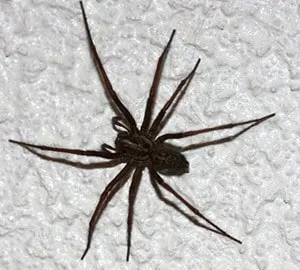
The many genera of wolf spiders range in body size (legs not included) from less than 10 to 35 mm (0.4 to 1.38 in). They have eight eyes arranged in three rows. The bottom row consists of four small eyes, the middle row has two very large eyes and the top row has two medium-sized eyes. Unlike most other spiders which are generally blind or have poor vision, wolf spiders have excellent eyesight.
Flashing a beam of light over the spider produces eyeshine; this eyeshine can be seen when the lighting source is roughly coaxial with the viewer or sensor. The light from the light source (e.g., a flashlight or sunlight) has been reflected from the spider’s eyes directly back toward its source, producing a “”glow”” that is easily noticed. Wolf spiders possess the third-best eyesight of all spider groups, bettered by jumping spiders and the huntsman spiders.
Wolf spiders are unique in the way that they carry their eggs. The egg sac, a round, silken globe, is attached to the spinnerets at the end of the abdomen, allowing the spider to carry her unborn young with her. The abdomen must be held in a raised position to keep the egg case from dragging on the ground. However, despite this handicap, they are still capable of hunting. Another aspect unique to wolf spiders is their method of care of young. Immediately after the spiderlings emerge from their protective silken case, they clamber up their mother’s legs and crowd onto the dorsal side of her abdomen. The mother carries the spiderlings for several weeks before they are large enough to disperse and fend for themselves. No other spiders are currently known to carry their young on their backs for any period of time.
Because they depend on camouflage for protection, they do not have the flashy appearance of some other kinds of spiders. In general, their coloration is appropriate to their favorite habitat.
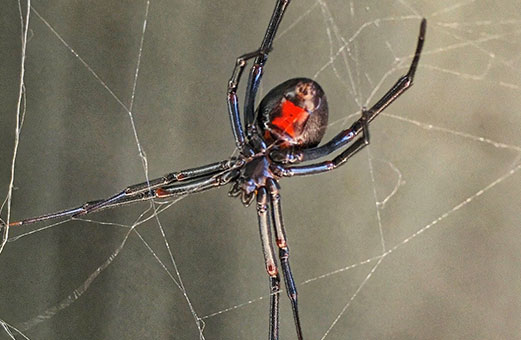
These spiders spin large webs in which females suspend a cocoon with hundreds of eggs. Spiderlings disperse soon after they leave their eggs, but the web remains. Black widow spiders also use their webs to ensnare their prey, which consists of flies, mosquitoes, grasshoppers, beetles, and caterpillars. Black widows are comb-footed spiders, which means they have bristles on their hind legs that they use to cover their prey with silk once it has been trapped.
To feed, black widows puncture their insect prey with their fangs and administer digestive enzymes to the corpses. By using these enzymes, and their gnashing fangs, the spiders liquefy their prey’s bodies and suck up the resulting fluid.
- Black widows are renowned for their potent venom, which they use to incapacitate their prey.
- Their glossy black bodies are adorned with a striking red hourglass marking, serving as a warning to potential predators.
- Despite their fearsome reputation, black widows tend to avoid human contact and often dwell in secluded areas.
- These spiders play a crucial role in controlling insect populations, contributing to the balance of ecosystems.
- The enigmatic behavior and appearance of black widows have fascinated scientists and nature enthusiasts for centuries.